
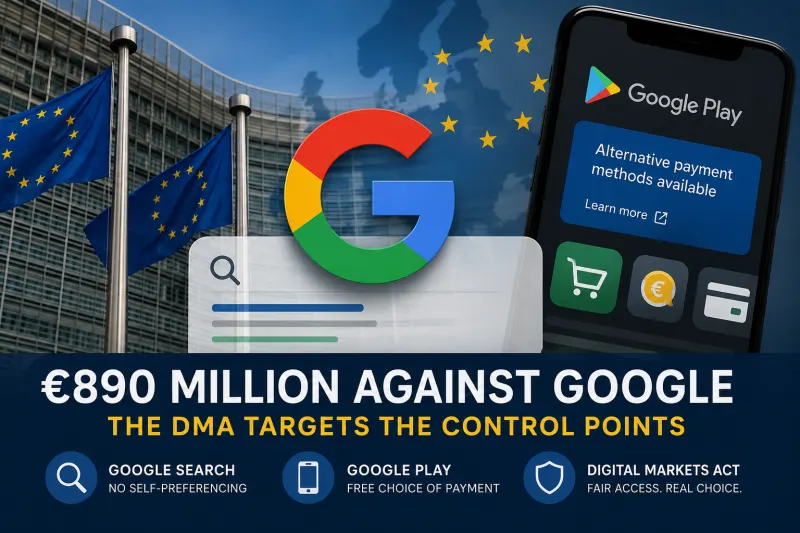
Die Zahl ist groß genug, um hängen zu bleiben: 890 Millionen Euro. Doch wer die Entscheidung der Europäischen Kommission nur als weiteres Bußgeld gegen Google liest, verfehlt den interessanteren Punkt. Brüssel greift hier nicht irgendeine Nebenpraxis an. Die Kommission zielt auf zwei Stellen, an denen Google im Alltag digitaler Märkte besonders viel Kontrolle ausübt: die Sichtbarkeit in der Suche und den Zugang zu Kunden im App-Ökosystem.
Sicherheit
890 Millionen Euro gegen Google: Der DMA greift an den Hebeln
← Alle Beiträge
Nach der Mitteilung der Europäischen Kommission stellte die Behörde am 23. Juli 2026 zwei Verstöße gegen den Digital Markets Act fest. Google soll in der Google-Suche eigene Dienste bevorzugt haben. Dafür verhängte die Kommission eine Geldbuße von 460 Millionen Euro. Eine weitere Strafe von 430 Millionen Euro betrifft Google Play: Dort soll Google Unternehmen daran gehindert haben, Verbraucher auf alternative, oft günstigere Kaufkanäle zu lenken.
Die Hauptthese dieser Entscheidung ist nüchtern: Der DMA wird nicht mehr nur als Regelwerk verhandelt. Er wird an den operativen Schaltstellen der Plattformökonomie durchgesetzt.
Die Strafe trifft nicht die Fassade, sondern die Steuerung
Google Search ist für viele Unternehmen kein gewöhnlicher Vertriebskanal. Sichtbarkeit dort entscheidet darüber, ob ein Angebot überhaupt gefunden wird. Wenn eine Plattform eigene Dienste an dieser Stelle bevorzugt, geht es nicht allein um Design oder Produktplatzierung. Es geht um den Zugriff auf Nachfrage. Wer die Suche kontrolliert, kontrolliert einen Teil der Marktverteilung.
Genau deshalb ist der Vorwurf der Selbstbevorzugung im DMA-Kontext so empfindlich. Die EU behandelt große Plattformen, die als Gatekeeper eingestuft werden, nicht wie beliebige Marktteilnehmer. Sie sieht sie als Betreiber von Zugangsinfrastruktur. Daraus folgt eine andere Logik: Ein Gatekeeper darf seine Stellung nicht nutzen, um angrenzende eigene Dienste systematisch besserzustellen.
Die zweite Entscheidung ist mindestens ebenso wichtig, auch wenn sie weniger sichtbar wirkt. Steering-Regeln auf Google Play betreffen den Weg vom Nutzer zur Zahlung. Wenn Unternehmen Verbraucher nicht auf alternative Kaufkanäle hinweisen oder dorthin lenken können, bleibt die Plattform nicht nur technischer Vermittler. Sie hält die Geschäftsbeziehung im eigenen Rahmen.
Das ist der Kern der Entscheidung: Die Kommission greift nicht nur Preisfragen oder einzelne Vertragsklauseln auf. Sie markiert die Punkte, an denen Plattformen Verhalten lenken können, ohne dass Nutzer es als Eingriff wahrnehmen müssen.
Warum das für Sicherheit relevant ist
Dies ist keine klassische Sicherheitsmeldung. Es geht nicht um eine Schwachstelle, keine Malware, keinen Angriff. Trotzdem gehört der Fall in eine Sicherheits-Einordnung, weil digitale Sicherheit längst nicht nur aus Patches und Zugangskontrollen besteht. Plattformmacht ist auch eine Frage operativer Abhängigkeit.
Unternehmen, die über Google Search gefunden werden müssen oder über Google Play Kunden erreichen, bewegen sich in Umgebungen, deren Regeln sie nicht selbst setzen. Diese Regeln bestimmen, welche Alternativen sichtbar sind, welche Zahlungswege praktisch erreichbar bleiben und welche Geschäftsmodelle innerhalb einer Plattform reibungslos funktionieren. Das ist kein abstrakter Regulierungsstoff. Es betrifft Risiko, Resilienz und Verhandlungsmacht.
Für Entwickler und Anbieter ist die Frage simpel: Können sie Kunden außerhalb des Plattformkanals erreichen, wenn das wirtschaftlich sinnvoll ist? Können sie sichtbar werden, ohne gegen einen integrierten Plattformdienst antreten zu müssen, der zugleich vom Betreiber der Infrastruktur bevorzugt wird? Die EU-Kommission beantwortet diese Fragen nicht mit einer Marktstudie, sondern mit zwei Bußgeldentscheidungen.
Der DMA erzwingt operative Trennung
Der Digital Markets Act setzt bei einem alten Problem an: Plattformen sind oft gleichzeitig Marktplatz, Regelsetzer und Wettbewerber. Diese Kombination ist nicht automatisch rechtswidrig. Sie wird aber heikel, wenn die Plattform ihre zentrale Stellung nutzt, um eigene Angebote besserzustellen oder alternative Wege zum Kunden zu erschweren.
Die Google-Entscheidung macht sichtbar, wie konkret die Pflichten werden. Es reicht nicht, öffentlich faire Bedingungen zu versprechen. Entscheidend ist, wie Ranking, Platzierung, Weiterleitung und Kaufprozesse tatsächlich organisiert sind. Der DMA zwingt damit zu einer Art operativer Trennung: Die Infrastruktur darf nicht stillschweigend zum Verstärker der eigenen Dienste werden.
Das kann für große Plattformen unangenehmer sein als eine einzelne Zahlung. Ein Bußgeld lässt sich verbuchen. Änderungen an Suchdarstellung, App-Store-Regeln und kommerziellen Flows greifen tiefer. Sie berühren die Mechanik, mit der Plattformen ihre Ökosysteme steuern.
Für Google ist die finanzielle Belastung erheblich. Strategisch schwerer wiegt aber, dass die Kommission zwei zentrale Kontrollflächen ausdrücklich adressiert: Suche und App-Vertrieb. Damit wird der Maßstab für künftige Prüfungen klarer. Nicht die Selbstdarstellung einer Plattform zählt, sondern das Verhalten an den Engpässen.
Wer dadurch mehr Spielraum bekommt
Die unmittelbaren Gewinner lassen sich vorsichtig benennen: Unternehmen, die in Google Search mit Google-eigenen Diensten konkurrieren, und Anbieter, die auf Google Play alternative Kaufkanäle nutzen möchten. Sie erhalten durch die Entscheidung nicht automatisch bessere Platzierungen oder niedrigere Kosten. Aber die Kommission macht deutlich, dass bestimmte Einschränkungen und Bevorzugungen unter dem DMA nicht einfach als normale Plattformpolitik durchgehen.
Auch Verbraucher könnten profitieren, wenn alternative Kaufkanäle tatsächlich sichtbarer oder leichter erreichbar werden. Die Kommission spricht selbst von oft günstigeren Kaufkanälen. Daraus folgt allerdings nicht, dass jede Transaktion billiger wird. Regulierung öffnet Optionen; sie garantiert keine Preissenkung im Einzelfall.
Für andere große Plattformbetreiber ist die Entscheidung ein Signal mit praktischer Bedeutung. Wer als Gatekeeper unter dem DMA steht, muss nicht nur juristische Texte prüfen, sondern Produktentscheidungen, Rankinglogiken, Vertragsbedingungen und Zahlungswege. Die Compliance-Frage wandert damit aus der Rechtsabteilung in Produkt- und Infrastrukturteams.
Die eigentliche Drohung ist die Wiederholbarkeit
890 Millionen Euro sind für sich genommen eine harte Sanktion. Doch die Wirkung des Falls hängt weniger an der Summe als an der Wiederholbarkeit der Logik. Wenn Brüssel bei Google Search und Google Play durchgreift, kann dieselbe Lesart auch andere Gatekeeper-Praktiken erfassen: Wo kontrolliert eine Plattform Zugang? Wo bevorzugt sie eigene Dienste? Wo erschwert sie den Wechsel oder den direkten Kontakt zum Kunden?
Das macht die Entscheidung so relevant. Sie verwandelt den DMA von einem politischen Versprechen in ein Prüfprogramm für reale Plattformprozesse. Für Google bedeutet das Anpassungsdruck. Für Wettbewerber bedeutet es eine belastbarere Grundlage, um Beschwerden an konkreten Praktiken festzumachen. Für Nutzer bleibt die Veränderung zunächst unspektakulär: vielleicht andere Hinweise, andere Wege, andere Platzierungen. Genau dort liegt aber die operative Bedeutung.
Digitale Macht zeigt sich selten als Verbotsschild. Sie steckt in Defaults, Rankings, Weiterleitungen und Abrechnungswegen. Die EU-Kommission hat mit dieser Entscheidung zwei solcher Hebel benannt und bepreist. Das ist weniger Theater als Verwaltungshandwerk. Aber für Plattformen kann gerade das gefährlich werden.
The figure is large enough to attract attention: €890 million.
But anyone who sees the European Commission’s decision as just another fine
against Google is missing the more important point. Brussels is not targeting
a minor business practice. The Commission is focusing on two areas where Google
exercises particularly significant control over digital markets: visibility
within search results and access to customers through the app ecosystem.
According to the European Commission, on 23 July 2026 the authority found Google
in breach of the Digital Markets Act in two separate cases. Google was fined
€460 million for allegedly favouring its own services within
Google Search. A further €430 million penalty concerns Google
Play, where the company was found to have prevented businesses from directing
consumers towards alternative and often cheaper purchasing channels.
The central message of these decisions is straightforward: the DMA is no longer
merely a regulatory framework on paper. It is now being enforced at the operational
control points of the platform economy.
For many businesses, Google Search is far more than a conventional marketing
channel. Visibility determines whether customers discover an offer at all.
When a platform gives preferential treatment to its own services, the issue
extends beyond interface design or product placement. It concerns control over
demand itself. Whoever controls search controls part of the market’s distribution.
This is precisely why allegations of self-preferencing are so significant under
the DMA. The European Union does not treat designated gatekeepers like ordinary
market participants. Instead, it regards them as operators of essential digital
infrastructure. That distinction creates different responsibilities: a gatekeeper
may not use its position to systematically favour its own adjacent services.
The second decision is at least as important, even though it may appear less
visible. Google Play’s steering rules concern the path from the user to payment.
If developers and businesses cannot inform customers about alternative purchasing
options or direct them towards those options, the platform becomes more than a
technical intermediary. It retains control over the commercial relationship.
This is the core of the Commission’s decision. It is not merely challenging pricing
practices or isolated contractual clauses. It is identifying the points where
platforms can influence user behaviour without users necessarily recognising
that influence.
This is not a traditional cybersecurity story. There is no software vulnerability,
malware campaign or data breach. Nevertheless, the case belongs in a broader
security analysis because digital security increasingly extends beyond software
patches and access controls. Platform power also creates operational dependencies.
Companies that rely on Google Search for visibility or Google Play for customer
acquisition operate within environments whose rules they do not control. Those
rules determine which alternatives become visible, which payment methods remain
practically accessible and which business models function smoothly within the
platform. This is not merely an abstract regulatory debate. It affects risk,
resilience and negotiating power.
For developers and businesses, the practical question is straightforward:
can they reach customers outside the platform ecosystem when doing so makes
commercial sense? Can they compete for visibility without facing a platform
operator that simultaneously controls the infrastructure and competes within it?
The European Commission has answered those questions not with another market
study, but with two enforcement decisions.
The Digital Markets Act addresses a longstanding structural problem. Major
platforms frequently serve as marketplace, rule-maker and competitor at the
same time. That combination is not automatically unlawful. It becomes problematic
when a platform uses its central position to favour its own services or make
alternative routes to customers more difficult.
The Google decisions show how concrete these obligations have become. Public
commitments to fairness are no longer sufficient. What matters is how rankings,
placements, redirects and purchasing processes actually operate. In practice,
the DMA requires a form of operational separation: the underlying infrastructure
must not quietly become a mechanism for promoting the platform operator’s own
commercial interests.
For large platforms, this requirement may prove more challenging than paying
a single fine. Financial penalties can be recorded as expenses. Changes to search
presentation, app-store policies and commercial workflows reach much deeper.
They alter the mechanics through which digital ecosystems are controlled.
For Google, the financial burden is substantial. Strategically, however, the
more important development is that the Commission has explicitly targeted two
central control surfaces: search and app distribution. That establishes a clearer
benchmark for future enforcement. What matters is not how a platform describes
itself, but how it behaves at the market’s critical bottlenecks.
The immediate beneficiaries can be identified cautiously. Businesses competing
with Google’s own services in search results and developers seeking to use
alternative purchasing channels through Google Play stand to gain the most.
The Commission’s decision does not automatically improve their rankings or reduce
their costs. It does, however, make clear that certain restrictions and forms of
preferential treatment cannot simply be treated as ordinary platform policy
under the DMA.
Consumers may also benefit if alternative purchasing channels become more visible
and easier to access. The Commission itself refers to purchasing options that are
often cheaper. That does not guarantee lower prices for every transaction.
Regulation creates additional options; it does not guarantee a particular outcome.
For other major platform operators designated as gatekeepers, the decision sends
a practical signal. Compliance is no longer solely a legal exercise. Product teams,
infrastructure engineers, ranking systems, contractual frameworks and payment
processes all become part of regulatory compliance.
On its own, €890 million represents a substantial financial
penalty. Yet the broader significance of the case lies less in the amount than
in the repeatability of the underlying logic. If the Commission applies this
reasoning to Google Search and Google Play, the same principles can be extended
to other gatekeeper practices.
Where does a platform control market access? Where does it favour its own services?
Where does it make switching providers or maintaining direct customer relationships
unnecessarily difficult?
That is what makes this decision so significant. It transforms the DMA from a
political commitment into an operational framework for examining how digital
platforms actually function. For Google, this creates pressure to adapt. For
competitors, it provides a stronger foundation for future complaints. For users,
the changes may initially appear subtle: different links, different payment
options and different rankings. Yet those apparently minor adjustments represent
the practical consequences of regulation.
Digital power rarely appears as an explicit prohibition. It is embedded in
defaults, rankings, redirects and payment flows. With these decisions, the
European Commission has identified two of those control points and attached
a financial cost to them. That may look more like administrative enforcement
than political theatre. For digital platforms, however, it could prove far
more consequential.
€890 Million Against Google: The DMA Targets the Control Points
The Fine Targets Control, Not Appearance
Why This Matters Beyond Cybersecurity
The DMA Forces Operational Separation
Who Gains More Freedom
The Real Threat Is Repeatability
Kategorie
Sicherheit
Datenlecks, Schwachstellen, Überwachung und Datenschutz – was du wissen solltest, bevor es zu spät ist.